

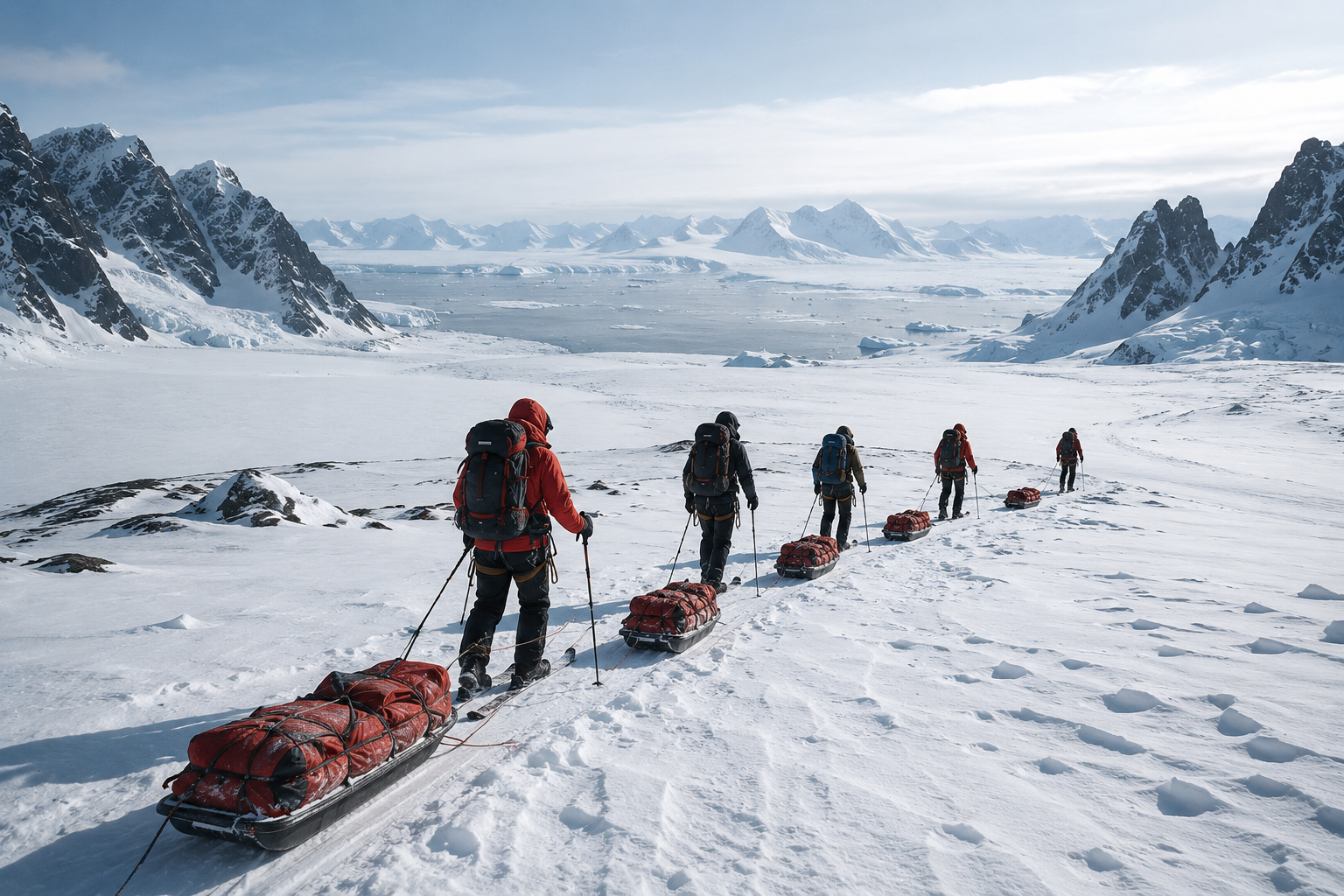
When Your Life Depends on It by Brad Borkan and David Hirzel is a compelling exploration of how leaders and teams make decisions under extreme conditions. Drawing from the legendary Antarctic expeditions of Ernest Shackleton, Roald Amundsen, Robert Falcon Scott, Douglas Mawson, and others, the authors examine what separates success from failure when uncertainty is high and the stakes are literally life and death.
The book is more than a collection of historical stories. It is a practical guide to decision-making, leadership, resilience, and risk management. The frozen wilderness of Antarctica serves as a powerful laboratory where human strengths and weaknesses are exposed. Every decision—from choosing a route to rationing food—had immediate consequences. The lessons derived from these expeditions remain highly relevant for entrepreneurs, executives, investors, military leaders, and anyone facing important life decisions.
The Antarctic as a Decision-Making Laboratory
Unlike modern leaders who can access data, experts, and technology, Antarctic explorers operated with limited information and few second chances. They had no reliable weather forecasts, no communication systems, and often no rescue options. Once an expedition began, every choice mattered.
The authors argue that these conditions mirror many situations in modern life. Whether launching a startup, making a career move, investing money, or leading an organization through uncertainty, people often must make decisions without complete information.
The key lesson is that great decision-makers do not wait for certainty. Instead, they gather the best information available, make informed choices, and adapt as circumstances evolve.
Amundsen vs. Scott: Preparation Beats Heroics
One of the most powerful comparisons in the book is the race to the South Pole between Roald Amundsen and Robert Falcon Scott.
Amundsen succeeded because he focused relentlessly on preparation. He studied previous expeditions, simplified his objectives, used proven transportation methods, and reduced unnecessary risks. His success was not based on luck or bravery alone—it was the result of disciplined planning and execution.
Scott, while courageous and accomplished, faced challenges caused by complex objectives, logistical difficulties, and a series of decisions that increased risk. His expedition ultimately ended in tragedy.
The lesson is clear: success often comes from meticulous preparation rather than heroic effort. Many failures occur not because people lack talent but because they underestimate the importance of planning.
Shackleton: The Ultimate Leadership Case Study
The book devotes significant attention to Ernest Shackleton and the famous Endurance expedition.
When Shackleton’s ship became trapped and eventually crushed by ice, the original mission became impossible. At that moment, many leaders might have clung to their initial goal. Shackleton did the opposite.
He immediately shifted priorities. Exploration no longer mattered. Survival became the mission.
His leadership during the crisis is one of history’s greatest examples of adaptability. He maintained morale, protected his team, communicated clearly, and made difficult decisions under immense pressure. Remarkably, every member of his crew survived.
Shackleton demonstrates that leadership is not about achieving a plan at all costs. It is about recognizing reality and helping people navigate it successfully.
Douglas Mawson and the Power of Resilience
Another extraordinary story is that of Douglas Mawson.
After losing a teammate and critical supplies in a crevasse accident, Mawson found himself stranded in Antarctica with little hope of survival. Facing starvation, exhaustion, and severe weather, he continued moving forward one step at a time.
His survival illustrates a profound lesson: resilience is not dramatic heroism. It is the ability to continue making rational decisions despite fear, uncertainty, and adversity.
The greatest challenges are often overcome not through extraordinary actions but through consistent, disciplined progress.
Risk Management and Decision-Making
Throughout the book, the authors emphasize the difference between calculated risk and reckless risk.
The explorers who succeeded were not fearless. They understood danger and prepared for it. They balanced ambition with caution and knew when to move forward and when to retreat.
This principle applies directly to modern business and life decisions. Successful leaders understand that avoiding all risk leads to stagnation, while embracing unmanaged risk leads to disaster.
The goal is not to eliminate uncertainty but to manage it intelligently.
Teamwork and Human Relationships
The Antarctic environment revealed the importance of teamwork. Technical skills alone were insufficient. Success depended on trust, cooperation, emotional stability, and shared commitment.
Shackleton, in particular, understood that managing morale was as important as managing supplies. He selected people carefully, resolved conflicts quickly, and kept everyone focused on common goals.
The book demonstrates that organizations and teams often succeed because of strong relationships rather than superior resources.
Why the Lessons Still Matter
Although few people face the extreme conditions of Antarctica, everyone faces uncertainty. Careers, businesses, investments, relationships, and major life decisions all require action before outcomes are known.
The explorers’ experiences teach us that uncertainty is unavoidable. What matters is how we respond to it. Preparation, adaptability, courage, and continuous learning remain essential qualities for navigating both professional and personal challenges.
The enduring message of the book is that successful decision-making is not about predicting the future. It is about responding effectively when the future unfolds differently than expected.
Must-Read Book Recommendation
Discover powerful lessons on decision-making, resilience, and survival.
Key Takeaways from the Book
- High-stakes decisions should be based on facts rather than emotions. Fear, stress, and urgency can cloud judgment, so remaining calm and objective is essential.
- Preparation and planning are critical. People who have rehearsed scenarios and considered possible risks are better equipped to respond when unexpected situations arise.
- Flexibility is more valuable than rigid adherence to plans. Conditions can change rapidly, and successful leaders adapt their strategies rather than stubbornly sticking to original assumptions.
- Small mistakes can accumulate into major disasters. Paying attention to minor warning signs and addressing problems early prevents larger consequences later.
- Effective decision makers constantly reassess their environment. Gathering new information and updating decisions accordingly helps avoid being trapped by outdated assumptions.
- Teamwork and communication are essential in extreme circumstances. Sharing information openly and encouraging different viewpoints improve the quality of decisions and reduce blind spots.
- Leaders should encourage dissent and constructive challenge. Teams perform better when members feel comfortable questioning assumptions and raising concerns without fear.
- Situational awareness is a vital skill. Understanding what is happening, anticipating future developments, and recognising emerging risks allow for faster and better responses.
- Decisions often need to be made with incomplete information. Waiting for perfect certainty may create greater risks than acting with the best information currently available.
- Experience matters, but it should not lead to complacency. Previous successes do not guarantee future success, and each situation should be evaluated on its own merits.
- The ability to prioritise is crucial during crises. Focusing on the most important issues first prevents distractions from consuming time and resources.
- Stress management is a key component of sound judgment. Maintaining physical and mental resilience improves the ability to think clearly under pressure.
- Successful decision makers balance caution with action. Excessive risk-taking and excessive hesitation can both lead to failure.
- Learning from mistakes strengthens future performance. Rather than assigning blame, effective individuals and organisations analyse failures to improve systems and processes.
- Awareness of cognitive biases is important. People tend to seek information that confirms their beliefs, underestimate risks, and become attached to previous decisions. Recognising these biases improves judgment.
- Discipline and consistency matter more than heroics. Survival and success in extreme environments depend on following sound processes and making a series of good decisions rather than relying on dramatic actions.
- One of the most important lessons from Antarctic expeditions is that survival often depends not on extraordinary talent, but on ordinary people consistently making thoughtful, informed, and adaptable decisions. The best leaders understand that uncertainty is inevitable and that resilience, humility, preparation, and teamwork are the foundations of effective decision-making when the stakes are highest.
Final Thoughts
When Your Life Depends on It offers timeless lessons drawn from some of the most remarkable stories of exploration ever recorded. Through the triumphs and failures of Antarctic pioneers, the book demonstrates that leadership, resilience, teamwork, and sound decision-making matter most when conditions are toughest.
Its greatest lesson is simple yet powerful: uncertainty is inevitable, but success belongs to those who prepare thoroughly, adapt quickly, learn continuously, and keep moving forward even when the outcome is unknown.