

Most people on this planet live through at least one overwhelming event: an accident, an assault, a disaster, combat, the sudden loss of someone they love or even war. Many entrepreneurs, even though resilient come across come across an incident which shakes them up – be it sudden even sudden closure of their startup, a personal loss in family or death, which if not controlled can lead to long term trauma, and impact their working lives.
Most recover on their own within weeks or months. For a size-able minority, though, the event refuses to stay in the past. It returns as intrusive memories and nightmares, as a body that stays on high alert, as avoidance of places and people, and as beliefs such as “I am not safe” or “It was my fault.”
When this pattern persists, it is diagnosed as post-traumatic stress disorder (PTSD), and in more pervasive forms that also involve problems with emotion regulation, self-worth and relationships, as complex PTSD.
The encouraging news, and the central message of this article, is that PTSD is among the most treatable conditions in mental health. Over the last decade, research has moved beyond the question “does therapy work?” to more practical questions: Which therapies work best? Can treatment be shorter, faster or delivered online? Do the benefits last?
This article draws on ten key peer-reviewed studies and reviews, most published between 2021 and 2025, to answer those questions and to set out what long-term recovery realistically looks like.
What “trauma-focused” therapy means
Trauma-focused therapies are psychological treatments that work directly with the memory of the traumatic event and with the meaning a person has drawn from it. That is different from therapies that teach only general coping skills such as relaxation or stress management.
Instead of helping you avoid the memory, a trauma-focused therapist helps you approach it in a structured, gradual and safe way, so that the brain can process it and file it as something that happened in the past rather than something that is still happening now.
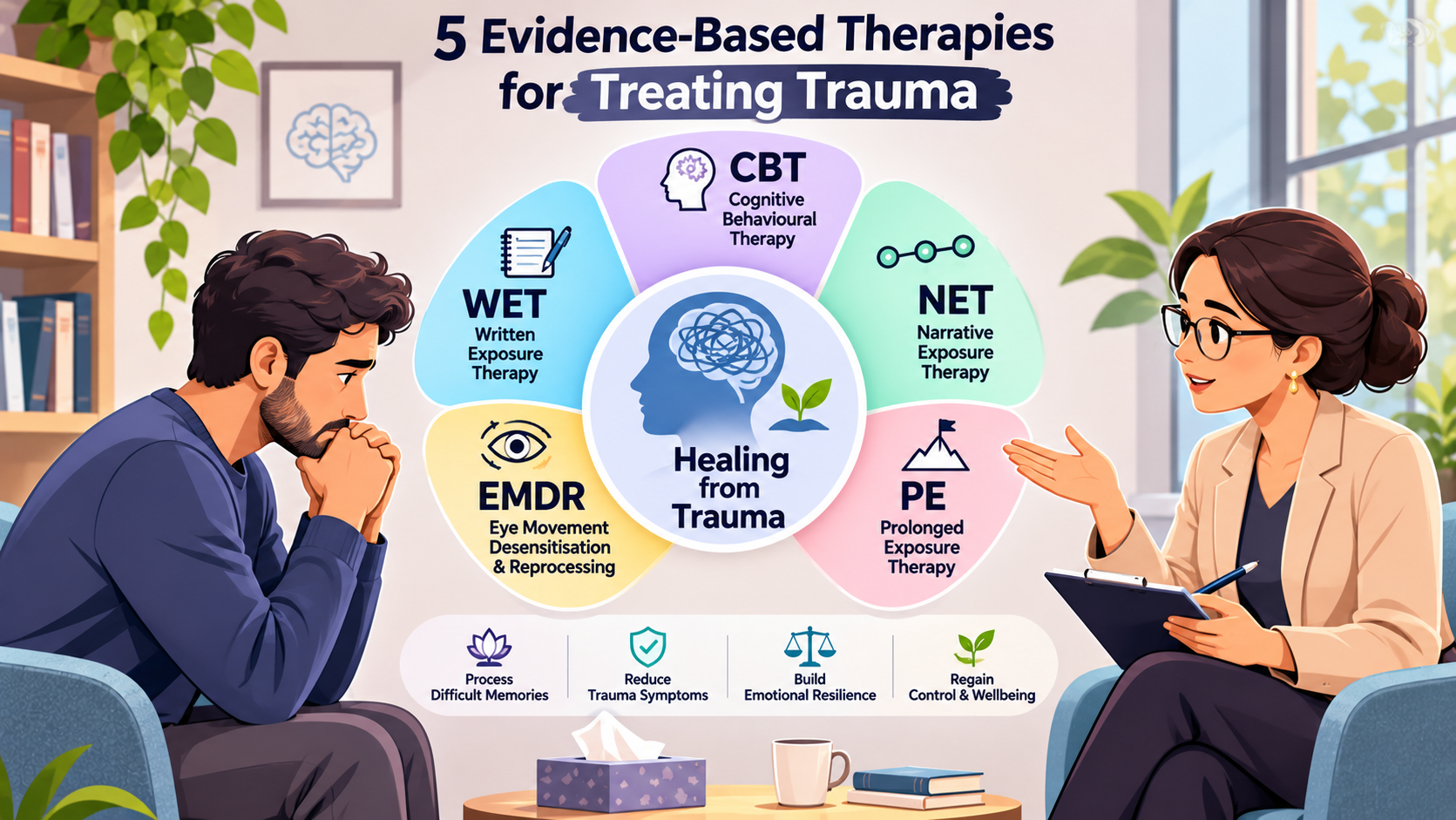
The best-studied trauma-focused therapies include:
Cognitive Processing Therapy (CPT)
CPT was developed by psychologist Patricia Resick, first for survivors of sexual assault, and is now one of the most widely used PTSD treatments in the world, including across the US Veterans Affairs system. It usually runs for about 12 weekly sessions.
Its starting point is that PTSD is kept going not only by the memory itself but by the conclusions a person draws from it. Early on, the client writes an “impact statement” about why they think the trauma happened and how it has changed their views of themselves, other people and the world. Therapist and client then identify “stuck points”: beliefs such as “I should have stopped it,” “I can never trust anyone again” or “I am permanently damaged.”
Using structured worksheets and Socratic questioning, the client learns to examine the evidence for these beliefs and to arrive at more balanced, accurate ones. Later sessions focus on five themes that trauma commonly disrupts: safety, trust, power and control, esteem, and intimacy.
CPT can be delivered with or without a detailed written account of the trauma, and it works in individual and group formats. Its strong research record, including top-ranked efficacy in network meta-analyses, makes it a first-line choice, especially for people troubled by guilt, shame or self-blame.
Prolonged Exposure (PE)
Prolonged Exposure was developed by Edna Foa and is based on emotional processing theory, the idea that avoiding trauma memories and reminders stops the brain from learning that they are no longer dangerous. A standard course runs for 8 to 15 weekly sessions of about 90 minutes.
Treatment begins with education about common reactions to trauma and a simple breathing technique for managing distress. The core has two parts. In imaginal exposure, the person recounts the trauma memory aloud, in the present tense and in detail, for 30 to 45 minutes, and then discusses it with the therapist.
Sessions are recorded so the client can listen again at home, and over time the focus narrows to the most distressing “hot spots.” In in vivo exposure, therapist and client build a ladder of situations that the person avoids but that are objectively safe, such as crowded shops, driving, or sitting with their back to a door, and the client works up it step by step. Distress usually rises at first and then falls as the brain learns that the memory is not the event and that reminders are not threats. PE has some of the deepest evidence of any PTSD therapy, and it also works well in the newer intensive, massed formats.
Eye Movement Desensitization and Reprocessing (EMDR)
EMDR was developed by Francine Shapiro in the late 1980s and is now recommended by the World Health Organization and many national guidelines. It rests on the adaptive information processing model: the idea that traumatic memories are stored in an unprocessed, “raw” form, which is why they feel so vivid and current.
Treatment follows eight phases, beginning with history-taking, preparation and building coping resources. In the processing phases, the client brings to mind a target image together with the negative belief, emotions and body sensations linked to it, while attending to bilateral stimulation, most often following the therapist’s hand or a light bar side to side, though taps or tones can also be used.
After each short set, the client notes what comes up, and the process continues until distress, rated on a 0–10 scale, falls close to zero.
A positive belief, such as “I survived” or “I am safe now,” is then strengthened. How the eye movements contribute is still debated; one leading explanation is that they tax working memory and make the memory less vivid. EMDR generally needs less homework than CBT, and trials show results comparable to trauma-focused CBT, with recent analyses suggesting it can be cost-effective.
Cognitive Therapy for PTSD (CT-PTSD)
Cognitive Therapy for PTSD is based on the cognitive model developed by Anke Ehlers and David Clark at Oxford.
The model explains PTSD as a persistent sense of current threat, driven by two things: negative appraisals of the trauma and its aftermath (“I’m going to die,” “My life is ruined”), and the way the trauma memory is stored, which is poorly linked to its context so that fragments of it are easily triggered and feel as if they are happening now.
A typical course is about 12 weekly sessions, plus booster sessions. Key techniques include memory updating, in which the person identifies the worst moments of the memory and links them to information that changes their meaning (for example, “I didn’t die” or “It wasn’t my fault”); stimulus discrimination, which trains the person to notice how present-day triggers differ from the original event; and site visits to where the trauma happened, which help place the memory firmly in the past.
Therapists also address unhelpful coping strategies such as rumination, thought suppression and excessive safety behaviours, and help clients “reclaim their life” by returning to valued activities. CT-PTSD has strong trial evidence, low dropout rates and well-tested intensive and internet versions such as iCT-PTSD.
Written Exposure Therapy (WET)
Written Exposure Therapy was developed by Denise Sloan and Brian Marx at the US National Center for PTSD as a deliberately brief, low-burden treatment.
It consists of just five sessions. The first lasts about an hour and includes education about PTSD and the rationale for writing. Each session then gives the client 30 minutes to write about the same traumatic memory, guided by scripted instructions.
Early sessions ask for a detailed account of what happened, including thoughts, feelings and sensations.
Later sessions increasingly ask about the meaning of the event: how it has affected the person’s life, relationships and view of themselves, and what they have learned from it.
The therapist checks in briefly before and after each writing period, but the writing itself does the main work. Unlike most trauma therapies, WET has no homework between sessions, which makes it easier for people with busy jobs, caring responsibilities or limited time.
Because it needs less therapist training and fewer sessions, it is also easier for health services to deliver at scale. Randomised trials in civilians and military personnel show it is non-inferior to the much longer CPT, with noticeably lower dropout rates, making it a strong choice for people who want an efficient route to recovery.
Narrative Exposure Therapy (NET)
Narrative Exposure Therapy was developed by Maggie Schauer, Frank Neuner and Thomas Elbert for people who have survived many traumatic events, such as refugees, survivors of war, torture or political violence, and children exposed to ongoing violence.
Rather than focusing on a single memory, NET works across the whole life story. In an early session the person lays out a “lifeline” using a rope or string, placing flowers to mark positive events and stones to mark traumatic ones.
Over the following sessions, which typically number between 4 and 12, the person and therapist work through life in chronological order.
When they reach a traumatic event, it is narrated in detail, with the therapist helping the person stay connected to both the emotions of the past and the safety of the present.
The therapist writes the story down, and it is read back and corrected at each session. At the end the person receives a written biography, which can also serve as testimony documenting human rights violations.
NET’s structure makes it well suited to low-resource settings: it can be taught to trained lay counsellors, and it has been tested in refugee camps and post-conflict regions. It is also associated with low dropout, which matters for people facing ongoing hardship.
Trauma-Focused CBT (TF-CBT) for children and adolescents
TF-CBT was developed by Judith Cohen, Anthony Mannarino and Esther Deblinger for children and young people aged roughly 3 to 18. It is the best-researched trauma treatment for young people. A course usually lasts 8 to 25 sessions, and a defining feature is that a non-offending parent or caregiver takes an active part throughout.
The components are often summarised with the acronym PRACTICE: Psychoeducation and parenting skills; Relaxation; Affect expression and regulation; Cognitive coping; Trauma narrative and processing; In vivo exposure to feared reminders; Conjoint child–caregiver sessions; and Enhancing safety and future development. The early sessions build the child’s ability to name and manage feelings and give caregivers tools to support them and handle difficult behaviour.
The child then gradually creates a trauma narrative, in words, drawings or a small book, and works on unhelpful thoughts such as “It was my fault.” Usually the narrative is then shared with the caregiver in a joint session, which can be powerful for both of them.
TF-CBT has been used after sexual abuse, domestic violence, traumatic grief, disasters and community violence. The large 2025 network meta-analysis described below found it linked to lasting reductions in PTSD in young people.
International guidelines, including those of the UK’s National Institute for Health and Care Excellence (NICE) and the US Departments of Veterans Affairs and Defense, recommend trauma-focused psychotherapy as the first-line treatment for PTSD, ahead of medication.
How the therapies compare: the big-picture evidence
Network meta-analysis lets researchers rank many treatments at once, combining head-to-head trials with indirect comparisons. Jericho, Luo and Berle (2022) used this method on 82 randomised trials covering 5,838 adults and 17 different psychotherapies.
They found that the leading treatments did not differ dramatically, but meta-cognitive therapy and cognitive processing therapy came out as the most effective. Written exposure therapy and narrative exposure therapy stood out for a lower risk of dropping out, which matters because a therapy only helps if people finish it.
An earlier network meta-analysis carried out for the NICE guideline (Mavranezouli et al., 2020) reached a similar conclusion from a different angle: EMDR, trauma-focused CBT, combined somatic and cognitive therapies, and guided self-help were among the most effective approaches for reducing PTSD symptoms in adults.
What about EMDR compared with other therapies? A 2024 individual participant data meta-analysis (Wright et al., 2024) pooled raw data from 346 patients across eight randomised trials. It found no significant difference between EMDR and other psychological treatments on symptom severity, response, remission or dropout.
In practical terms, EMDR and trauma-focused CBT are both strong options. The best choice often depends on availability, the therapist’s skill, and which approach feels acceptable to the person.
The overall picture is reassuring. There is no single “magic” therapy. There is a group of well-tested trauma-focused treatments that all work well, and the common ingredient is engaging with the trauma memory and its meaning rather than avoiding it.
Shorter and faster: the newest delivery formats
Traditional courses of CPT or PE run for 8 to 15 weekly sessions, often with homework. Many people drop out because of time, cost, work or the emotional burden of stretching treatment over months. Much recent research has asked whether treatment can be made shorter or more concentrated without losing effectiveness.
Written Exposure Therapy: five sessions
In a randomised non-inferiority trial with 126 adults, Sloan, Marx, Lee and Resick (2018) compared five sessions of WET with twelve sessions of CPT. Both groups improved substantially, and WET was non-inferior to CPT despite the large difference in the number of sessions.
A follow-up trial with 169 active-duty military service members (Sloan et al., 2022) confirmed that WET was non-inferior to CPT and found significantly lower dropout with WET. Because WET has no homework between sessions, it can be a realistic option for people with demanding lives.
Massed (intensive) Prolonged Exposure: treatment in two to three weeks
Instead of one session a week, “massed” treatment delivers sessions daily or nearly daily. In a large trial with 366 active-duty military personnel, Foa and colleagues (2018) showed that ten sessions of PE delivered over two weeks were non-inferior to the same ten sessions spread over eight weeks.
Peterson et al. (2023) then compared two compressed formats in 234 service members and veterans. Around six in ten people in the massed group no longer met criteria for PTSD at the end of treatment, and more than half of both groups were still in remission six months later.
A twelve-month follow-up of an Australian trial (Dell et al., 2023) also supported massed PE as a lasting alternative to standard weekly treatment.
The practical lesson is that intensive formats can bring relief in weeks rather than months, and they appear to reduce the dropout that weakens standard care.
Therapy online: digital trauma-focused treatment
Access remains one of the biggest barriers to recovery, especially in countries with too few trained therapists. The STOP-PTSD trial (Ehlers et al., 2023, Lancet Psychiatry) tested an internet version of cognitive therapy for PTSD (iCT-PTSD) with 217 adults in the UK. Therapist support was given through messages and short weekly phone calls.
The trauma-focused online programme beat a well-designed online stress-management programme, fewer than 10% of participants dropped out, and both online treatments produced large improvements compared with a waiting list. Notably, about a quarter of participants met criteria for complex PTSD.
The RAPID trial (Bisson et al., 2022, BMJ) found that a guided internet-based trauma-focused CBT programme was non-inferior to face-to-face therapy for mild to moderate PTSD after a single traumatic event. Guided digital programmes are now a credible first step for many people, although more severe or complex presentations usually still call for face-to-face care.
Children and adolescents
Children develop PTSD too, and early effective treatment can change the course of a life. The most comprehensive review to date (Hoppen et al., 2025, JAMA Psychiatry) analysed 70 randomised trials involving 5,528 young people.
Trauma-focused CBT was the most studied treatment and was linked to significant reductions in PTSD in the short, medium and long term. EMDR and multidisciplinary treatments also showed short-term benefits, though long-term data for these are still limited.
For parents, the message is that structured, evidence-based trauma therapy for children works, and involving caregivers is usually part of it.
Emerging frontier: MDMA-assisted therapy
No article on the latest developments would be complete without psychedelic-assisted therapy. In the MAPP2 phase 3 trial (Mitchell et al., 2023, Nature Medicine), 104 adults with moderate to severe PTSD received either MDMA or a placebo, each combined with the same intensive therapy programme. The MDMA group showed greater symptom reduction, with an average 23.7-point drop on the clinician-rated CAPS-5 scale compared with 14.8 points for placebo plus therapy, and the treatment was generally well tolerated in the trial setting.
This remains an experimental, unapproved treatment. In August 2024 the US Food and Drug Administration declined to approve MDMA-assisted therapy, asking for more evidence on how durable the response is, a fuller safety picture, and steps to reduce bias in the trials. The developer, now Resilient Pharmaceuticals, resubmitted its application in August 2026, and a decision is pending. Two points are worth noting. First, the placebo group, who received therapy alone, also improved substantially, which underlines how much the therapy itself contributes. Second, MDMA should never be used outside a regulated clinical setting.
Does recovery last? The long-term evidence
A reasonable question for anyone considering therapy is whether the improvement will hold or whether symptoms will come back. Here the research is encouraging.
A systematic review and meta-analysis by Weber et al. (2021, Psychological Medicine) examined 22 studies with 2,638 patients and focused on outcomes at least a year after treatment. Active psychological treatments produced large improvements from the start of treatment to long-term follow-up, and gains in both PTSD and depression stayed stable from the end of treatment to follow-up.
The authors concluded that CBT for PTSD is effective in the long term. An earlier meta-analysis of trials with follow-up of at least six months (Kline et al., 2018) reached a similar conclusion about the enduring effects of psychotherapy for PTSD.
Some individual studies have followed people for much longer. Resick and colleagues (2012) reassessed participants five to ten years after they had received CPT or PE and found that the improvements were largely maintained. Bryant et al. (2021) found that the benefits of trauma-focused CBT for emergency service workers lasted at least two years.
The long-term research also shows where recovery is harder. Weber et al. (2021) found smaller long-term effects in military samples, and studies of complex, repeated trauma, such as in war-affected populations, show reduced effects. People in these groups can still recover, but they may need longer treatment, combined approaches, or follow-up “booster” sessions.
Can trauma be “cured”? A realistic view of long-term recovery
It helps to be precise about language. Therapy does not erase a memory, and it should not. What effective treatment does is change the memory’s grip on your life. The memory becomes something you can recall without being flooded by it, the alarm system settles, and the beliefs that trapped you, such as “I’m broken” or “the world is completely dangerous”, lose their power.
In research terms, many people reach remission, meaning they no longer meet the criteria for PTSD, and the long-term studies above show that this remission usually lasts. For many people that is, in every meaningful sense, recovery.
Based on the evidence, these steps give you the best chance of lasting recovery:
- Choose a trauma-focused therapy with strong evidence. Ask a prospective therapist directly whether they are trained in CPT, PE, EMDR, CT-PTSD, WET or NET. General supportive counselling is valuable, but it is not the first-line treatment for PTSD.
- Finish the course. Dropout is one of the main reasons treatment fails. If weekly sessions are hard to sustain, ask about brief options such as WET or intensive, massed formats.
- Expect discomfort, and know that it passes. Approaching the memory is uncomfortable at first. That is the process working, not a sign of harm. A good therapist will pace it carefully.
- Reduce avoidance in daily life. Avoidance is what keeps PTSD going. Gradually returning to safe places, activities and relationships you have been avoiding consolidates the gains you make in therapy.
- Address what comes with PTSD. Depression, sleep problems, alcohol or drug use and chronic pain often accompany trauma. Treating them alongside PTSD protects long-term recovery.
- Build a relapse-prevention plan. Before ending therapy, work out your personal warning signs, the skills that helped most, and when to return for a booster session. Anniversaries, new stresses or fresh trauma can bring symptoms back temporarily, and a plan helps you respond early.
- Invest in connection and the basics. Social support, regular sleep, physical activity and meaningful routines are consistently linked with better outcomes. They are not a replacement for therapy, but they help to sustain it.
- Consider digital options if access is a barrier. Guided, internet-based trauma-focused programmes have shown strong results for many people with mild to moderate PTSD.
- Be cautious about unproven “quick fixes”. Promising new treatments such as MDMA-assisted therapy belong in regulated clinical settings and trials, not in self-experimentation.
If you are in crisis or having thoughts of harming yourself, contact local emergency services or a crisis helpline right away. Trauma therapy is most effective once immediate safety is in place.
Conclusion
The science of trauma treatment has never been stronger. Several trauma-focused therapies, including CPT, PE, EMDR, cognitive therapy and written exposure therapy, consistently reduce PTSD, and the differences between them are small.
Newer formats make treatment shorter, more intensive or available online without giving up effectiveness, and treatment for children is well supported. Long-term follow-ups, some extending past five years, show that the gains usually last.
Trauma does not have to be a life sentence. With the right therapy, completed fully and supported by a plan for the future, most people can move from surviving to living well.
(This article is for general information and is not a substitute for assessment and treatment by qualified mental health professionals. A research based review of 10 studies)
References:
- Jericho, B., Luo, A., & Berle, D. (2022). Trauma-focused psychotherapies for post-traumatic stress disorder: A systematic review and network meta-analysis. Acta Psychiatrica Scandinavica, 145(2), 132–155. https://doi.org/10.1111/acps.13366
- Mavranezouli, I., Megnin-Viggars, O., Daly, C., Dias, S., Welton, N. J., Stockton, S., et al. (2020). Psychological treatments for post-traumatic stress disorder in adults: A network meta-analysis. Psychological Medicine, 50(4), 542–555. https://doi.org/10.1017/S0033291720000070
- Wright, S. L., Karyotaki, E., Cuijpers, P., Bisson, J., Papola, D., Witteveen, A., et al. (2024). EMDR v. other psychological therapies for PTSD: A systematic review and individual participant data meta-analysis. Psychological Medicine, 54(8), 1580–1588. https://doi.org/10.1017/S0033291723003446
- Sloan, D. M., Marx, B. P., Lee, D. J., & Resick, P. A. (2018). A brief exposure-based treatment vs cognitive processing therapy for posttraumatic stress disorder: A randomized noninferiority clinical trial. JAMA Psychiatry, 75(3), 233–239. https://doi.org/10.1001/jamapsychiatry.2017.4249
- Sloan, D. M., Marx, B. P., Resick, P. A., Young-McCaughan, S., Dondanville, K. A., Straud, C. L., et al. (2022). Effect of written exposure therapy vs cognitive processing therapy on increasing treatment efficiency among military service members with posttraumatic stress disorder: A randomized noninferiority trial. JAMA Network Open, 5(1), e2140911.
- Peterson, A. L., Blount, T. H., Foa, E. B., Brown, L. A., et al. (2023). Massed vs intensive outpatient prolonged exposure for combat-related posttraumatic stress disorder: A randomized clinical trial. JAMA Network Open, 6(1), e2249422. https://doi.org/10.1001/jamanetworkopen.2022.49422
- Ehlers, A., Wild, J., Warnock-Parkes, E., Grey, N., Murray, H., Kerr, A., et al. (2023). Therapist-assisted online psychological therapies differing in trauma focus for post-traumatic stress disorder (STOP-PTSD): A UK-based, single-blind, randomised controlled trial. The Lancet Psychiatry, 10(8), 608–622.
- Mitchell, J. M., Ot’alora G., M., van der Kolk, B., et al. (2023). MDMA-assisted therapy for moderate to severe PTSD: A randomized, placebo-controlled phase 3 trial. Nature Medicine, 29, 2473–2480. https://doi.org/10.1038/s41591-023-02565-4
- Hoppen, T. H., Wessarges, L., Jehn, M., Mutz, J., et al. (2025). Psychological interventions for pediatric posttraumatic stress disorder: A systematic review and network meta-analysis. JAMA Psychiatry, 82(2), 130–141.
- Weber, M., Schumacher, S., Hannig, W., Barth, J., Lotzin, A., Schäfer, I., Ehring, T., & Kleim, B. (2021). Long-term outcomes of psychological treatment for posttraumatic stress disorder: A systematic review and meta-analysis. Psychological Medicine, 51(9), 1420–1430. https://doi.org/10.1017/S003329172100163X
Supporting references
- Bisson, J. I., Ariti, C., Cullen, K., Kitchiner, N., Lewis, C., Roberts, N. P., et al. (2022). Guided, internet based, cognitive behavioural therapy for post-traumatic stress disorder: Pragmatic, multicentre, randomised controlled non-inferiority trial (RAPID). BMJ, 377, e069405. https://doi.org/10.1136/bmj-2021-069405
- Bryant, R. A., et al. (2021). Two-year follow-up of trauma-focused cognitive behavior therapy for posttraumatic stress disorder in emergency service personnel: A randomized clinical trial. Depression and Anxiety, 38(11), 1131–1137. https://doi.org/10.1002/da.23214
- Dell, L., Sbisa, A. M., Forbes, A., O’Donnell, M., Bryant, R., Hodson, S., et al. (2023). Massed v. standard prolonged exposure therapy for PTSD in military personnel and veterans: 12-month follow-up of a non-inferiority randomised controlled trial. Psychological Medicine. https://doi.org/10.1017/S0033291723000405
- Foa, E. B., McLean, C. P., Zang, Y., Rosenfield, D., Yadin, E., Yarvis, J. S., et al. (2018). Effect of prolonged exposure therapy delivered over 2 weeks vs 8 weeks vs present-centered therapy on PTSD symptom severity in military personnel: A randomized clinical trial. JAMA, 319(4), 354–364.
- Kline, A. C., Cooper, A. A., Rytwinski, N. K., & Feeny, N. C. (2018). Long-term efficacy of psychotherapy for posttraumatic stress disorder: A meta-analysis of randomized controlled trials. Clinical Psychology Review, 59, 30–40.
- Resick, P. A., Williams, L. F., Suvak, M. K., Monson, C. M., & Gradus, J. L. (2012). Long-term outcomes of cognitive–behavioral treatments for posttraumatic stress disorder among female rape survivors. Journal of Consulting and Clinical Psychology, 80(2), 201–210.
- Simpson, et al. (2025). Clinical and cost-effectiveness of eye movement desensitization and reprocessing for treatment and prevention of post-traumatic stress disorder in adults: A systematic review and meta-analysis. British Journal of Psychology. https://doi.org/10.1111/bjop.70005
- Multidisciplinary Association for Psychedelic Studies (MAPS). (2026, August 10). MAPS responds to report of progress for MDMA-assisted therapy for PTSD with FDA. https://maps.org/?p=360957