

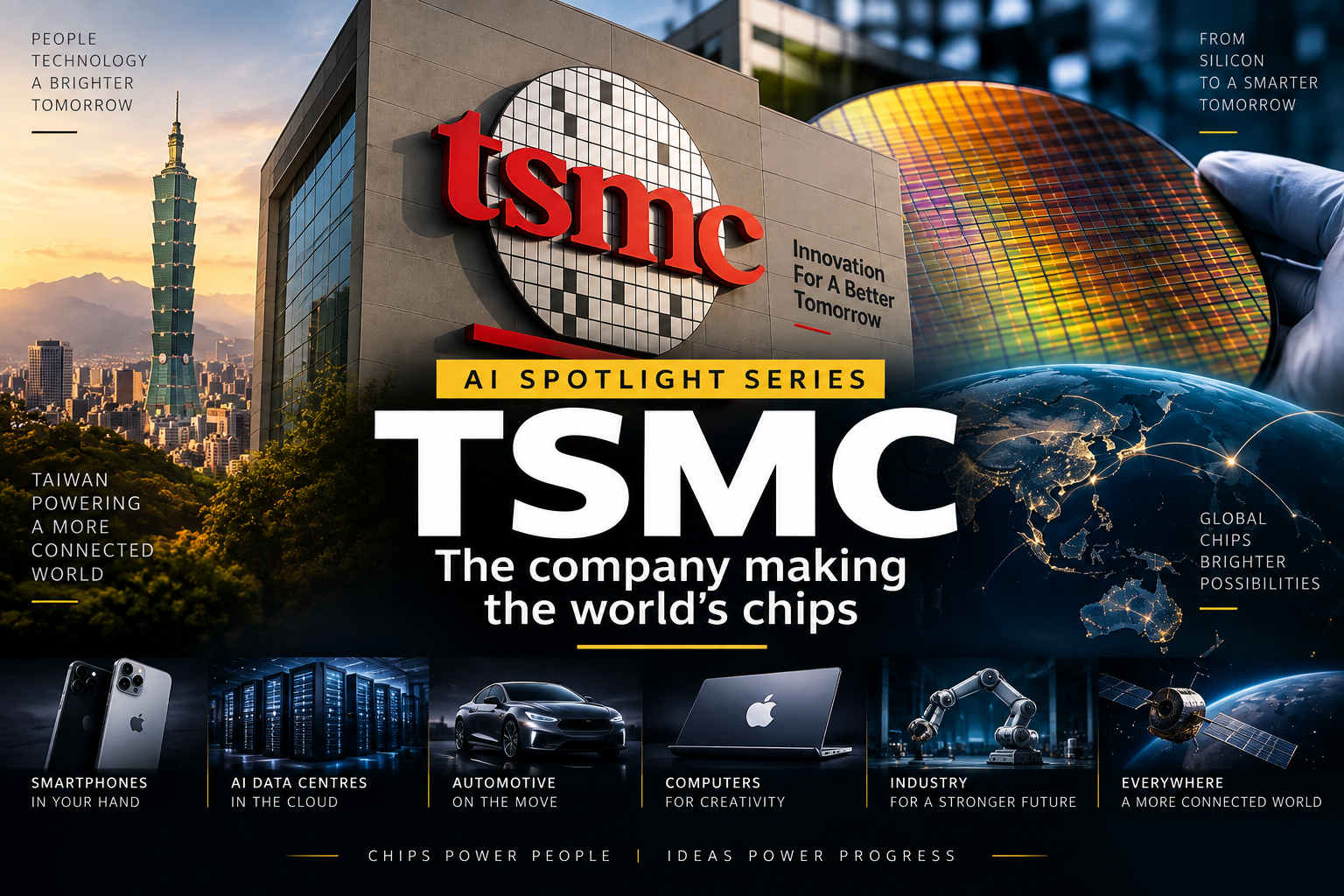
From Morris Chang’s unconventional startup idea in 1987 to the manufacturing backbone of NVIDIA, Apple, AMD, Qualcomm and the AI revolution — and the geopolitical company sitting at the centre of the US-China technology struggle.
There is a simple question that explains why Taiwan Semiconductor Manufacturing Company has become one of the most important companies in the world:
Who actually makes the chips?
NVIDIA designs some of the world’s most powerful AI processors.
Apple designs its own chips for iPhones, Macs and other devices.
AMD designs CPUs and GPUs.
Qualcomm designs processors and communications chips.
Broadcom designs networking and specialised semiconductor products.
But many of the world’s most advanced chips are manufactured by one company:
TSMC.
That makes TSMC fundamentally different from most technology companies.
It doesn’t sell smartphones.
It doesn’t sell PCs.
It doesn’t operate a consumer AI chatbot.
It doesn’t put its own brand on the chips it manufactures.
Instead, it provides the manufacturing infrastructure that allows some of the world’s most valuable technology companies to turn semiconductor designs into physical products.
In 2025 alone, TSMC manufactured 12,682 different products using 305 technologies for 534 customers.
Its chips were used across high-performance computing, smartphones, automotive, IoT and consumer electronics.
The company managed more than 17 million 12-inch-equivalent wafers of annual capacity.
But TSMC wasn’t born as an obvious winner.
Its story begins with a 55-year-old engineer, a relatively small semiconductor industry in Taiwan and an idea that challenged the traditional way chips were made.

Morris Chang: The founder who started at 55
Morris Chang’s story is unusual by Silicon Valley standards.
He wasn’t a 25-year-old founder working from a garage.
He had already spent decades in the semiconductor industry.
Born in Ningbo, China, Chang moved to the United States and studied at MIT before earning a PhD in electrical engineering from Stanford.
In 1958, he joined Texas Instruments, where he spent more than two decades and rose through the organisation, eventually becoming responsible for major parts of its semiconductor business.
He later became president and chief operating officer of General Instrument.
Then Taiwan came calling.
In 1985, Chang became president of Taiwan’s Industrial Technology Research Institute — ITRI.
Taiwan wanted to develop a high-technology economy.
Chang saw an opportunity.
But he also understood Taiwan’s limitations.
Taiwan did not yet have Intel’s brand.
It did not have the scale of America’s largest semiconductor companies.
It could not simply copy Silicon Valley.
So Chang asked a different question:
What could Taiwan become exceptionally good at?
The answer would change the semiconductor industry forever.
The semiconductor industry had a problem
During the 1970s and early 1980s, companies generally designed and manufactured their own chips.
If you wanted to build a sophisticated semiconductor company, you needed a semiconductor factory — a fab.
That was an enormous barrier.
A new chip company could have brilliant engineers and a brilliant design, but without a fab it couldn’t manufacture the product.
Building a fab required enormous capital.
And maintaining one required continuous investment in increasingly sophisticated equipment and processes.
Chang saw that this was creating a structural problem.
There were talented engineers who wanted to design chips.
There were companies that wanted to create semiconductor products.
But very few could afford to own and operate advanced manufacturing facilities.
What if someone built the factories for them?
What if that company never competed with its customers?
That was the founding idea behind TSMC.
1987: A radically different company
TSMC was established on February 21, 1987.
The company was founded by Morris Chang with support from the government of Taiwan, Philips and private investors.
It became the world’s first major pure-play semiconductor foundry.
Its business model was deliberately different.
TSMC would manufacture chips designed by other companies.
It would not design and sell competing chips under its own brand.
The principle was extraordinarily simple:
Your success is our success.
TSMC’s charter and business model were designed specifically so it would not compete with its customers.
That made it possible for companies to trust TSMC with some of their most valuable intellectual property.
At the time, however, nobody knew whether the model would work at scale.
The startup years
TSMC’s first years were not the glamorous beginning of a technology giant.
The company had to convince semiconductor companies to trust a new Taiwanese manufacturer with their products.
It needed to prove quality.
It needed to prove yields.
It needed to prove reliability.
And it needed to continually invest in manufacturing technology.
The company nevertheless became profitable remarkably quickly.
According to its early history, TSMC began making a profit just two years after its founding, in 1988.
By 1994, it was publicly listed on the Taiwan Stock Exchange.
By the end of 1995, it was already the world’s largest foundry.
But the most important development was happening outside TSMC.
The entire semiconductor industry was beginning to change.
The rise of the fabless company
TSMC helped create a new category of semiconductor company:
the fabless chip designer.
A company no longer needed to own a factory.
It could concentrate on architecture, engineering, software and product development.
TSMC would manufacture the silicon.
This changed the economics of innovation.
And eventually it allowed a new generation of semiconductor companies to emerge.
Among the most important would be:
- NVIDIA
- AMD
- Qualcomm
- Broadcom
- MediaTek
- Marvell
Many of these companies could devote enormous resources to chip design without having to become giant manufacturers themselves.
TSMC became the manufacturing platform underneath them.
That was the beginning of its extraordinary strategic position.
Who actually buys TSMC’s chips?
This is where TSMC becomes particularly interesting.
TSMC doesn’t normally sell a chip directly to a consumer.
Its customers design chips, and TSMC manufactures them.
So when someone buys an iPhone, AI server, graphics card or advanced networking system, they may be buying a product containing silicon manufactured by TSMC.
The company’s major customers include some of the most important names in technology.
TSMC itself identifies customers including Apple, NVIDIA, AMD, Broadcom and Qualcomm among the leading US technology and AI companies it supports.
1. NVIDIA — the AI revolution
Perhaps the most strategically important TSMC relationship today is NVIDIA.
NVIDIA designs GPUs and accelerated-computing platforms.
TSMC manufactures many of NVIDIA’s most advanced processors.
These chips power:
- AI training;
- AI inference;
- ChatGPT-style systems;
- large language models;
- cloud AI;
- scientific computing;
- autonomous systems;
- robotics;
- advanced graphics.
The extraordinary growth of generative AI has therefore created a second-order boom for TSMC.
The chain looks like this:
AI models → AI infrastructure → NVIDIA GPUs → TSMC manufacturing.
The more AI compute the world demands, the more advanced semiconductor manufacturing is required.
And the more sophisticated those chips become, the more important TSMC’s leading-edge processes and advanced packaging become.
2. Apple — the smartphone and personal-computing giant
Apple is another crucial customer.
Apple designs its own semiconductor architecture, including its A-series processors for iPhones and M-series chips for Macs and other products.
TSMC manufactures Apple’s advanced processors.
Those chips power:
- iPhones;
- iPads;
- Mac computers;
- Apple intelligence features;
- cameras and image processing;
- graphics;
- machine learning;
- power management.
This relationship illustrates TSMC’s original business model perfectly.
Apple gets to concentrate on designing the processor.
TSMC concentrates on manufacturing it.
Neither needs to become the other.
3. AMD — CPUs and GPUs
AMD is another important customer.
AMD designs:
- Ryzen processors;
- EPYC server CPUs;
- Radeon GPUs;
- Instinct AI accelerators.
Those products serve PCs, gaming, cloud computing and AI data centres.
TSMC’s advanced process technology allows AMD to produce increasingly sophisticated processors without owning its own leading-edge manufacturing network.
The relationship therefore represents one of the clearest examples of the fabless model that TSMC helped create.
4. Qualcomm — the mobile-computing revolution
Qualcomm is another major TSMC customer.
Its semiconductor designs are found throughout the mobile ecosystem.
They power:
- smartphones;
- cellular connectivity;
- Wi-Fi;
- automotive systems;
- edge AI;
- connected devices.
The smartphone revolution was enormously important to TSMC because it created sustained demand for increasingly powerful and energy-efficient processors.
Today that requirement is being extended by AI.
The smartphone is becoming an AI computer in your pocket.
5. Broadcom — networking the AI data centre
Broadcom occupies a different but increasingly important position.
Its semiconductor products are critical to:
- data-centre networking;
- high-speed connectivity;
- custom accelerators;
- communications infrastructure;
- AI clusters.
AI isn’t just about GPUs.
Thousands of processors need to communicate with each other.
Data has to move between CPUs, GPUs, memory and storage.
Broadcom’s networking and connectivity technologies therefore become increasingly important as AI clusters grow.
And again, TSMC is part of the manufacturing foundation.
Where TSMC’s chips end up
The company’s customer list is only half the story.
The other half is where the resulting chips are used.
TSMC’s 2025 revenue illustrates how dramatically AI and high-performance computing have changed its business.
2025 revenue by platform
- High Performance Computing — 58%
- Smartphones — 29%
- IoT — 5%
- Automotive — 5%
- Digital Consumer Electronics — 1%
- Other — 2%
HPC revenue grew 48% year-on-year.
Automotive grew 34%.
IoT grew 15%.
Smartphone revenue increased 11%.
This is significant because HPC has overtaken smartphones as TSMC’s largest revenue platform.
In other words:
AI and high-performance computing are changing the centre of gravity of TSMC’s business.
From phones to AI factories
Consider what happens inside an AI data centre.
There are:
- GPUs;
- CPUs;
- networking processors;
- custom accelerators;
- switches;
- controllers;
- storage components;
- advanced packaging;
- high-speed interconnects.
Many of the most advanced processors in that ecosystem are manufactured using TSMC technologies.
This means TSMC doesn’t need to predict which AI model will win.
It doesn’t need to know whether NVIDIA, AMD, Google, Amazon or another company will dominate AI.
It can supply the manufacturing platform to many of them.
That is an extraordinary strategic position.
The technology race: 7nm → 5nm → 3nm → 2nm
TSMC’s advantage has been built through relentless process innovation.
In 2025:
- 3nm represented 24% of wafer revenue;
- 5nm represented 36%;
- 7nm represented 14%.
Together, technologies at 7nm and below represented 74% of total wafer revenue.
Then came the next major milestone.
TSMC’s 2nm technology entered high-volume manufacturing in Q4 2025.
By Q2 2026, 2nm already accounted for 3% of wafer revenue, while 3nm represented 30%, 5nm 33% and 7nm 11%.
Advanced technologies at 7nm and below represented 77% of wafer revenue in Q2.
This is the manufacturing race underneath the AI race.
The financial transformation
The numbers show what this technology leadership has become worth.
TSMC 2025
| Metric | 2025 |
|---|---|
| Revenue | US$122.42B |
| Net income | US$55.21B |
| Gross margin | 59.9% |
| Operating margin | 50.8% |
| Net margin | 45.1% |
| Advanced technology revenue | 74% |
Revenue increased 35.9% in US-dollar terms.
Net income increased 51.2%.
Both revenue and EPS reached record highs.
These are extraordinary numbers for a manufacturing company.
But TSMC is no ordinary manufacturer.
2026: AI pushes the numbers higher
In Q2 2026, TSMC reported:
US$40.20 billion revenue
US$22.4 billion-equivalent net income
67.7% gross margin
60.3% operating margin
55.6% net profit margin
Revenue rose 33.7% year-on-year.
Net income increased 77.4%.
The company forecast Q3 revenue of approximately US$44.6–45.8 billion.
This is the financial consequence of becoming a critical manufacturing bottleneck for the AI industry.
The stock: investors discover the AI factory
TSMC trades in Taiwan under 2330 and in the United States through its NYSE ADR under TSM.
The market has increasingly recognised that TSMC isn’t simply benefiting from semiconductor demand.
It is positioned at the intersection of several enormous trends:
AI + cloud computing + smartphones + advanced computing + automotive + edge AI.
The stock has nevertheless experienced major cycles.
Semiconductor manufacturing is capital intensive.
Demand can fall.
Inventory can build.
Technology transitions can create uncertainty.
Geopolitical risk can affect valuation.
So TSMC’s investment story is not simply:
“AI is growing, therefore TSMC goes up.”
The real investment thesis is more complicated:
TSMC possesses a technological and manufacturing position that is exceptionally difficult to reproduce.
And then TSMC became a geopolitical company
This is where TSMC’s story becomes unlike almost any other technology company.
Its headquarters and most advanced manufacturing capabilities are concentrated in Taiwan.
Taiwan is a self-governing democracy.
Beijing claims Taiwan as part of China.
The United States has deep economic and technological ties with Taiwan while maintaining its own diplomatic framework with Beijing.
The semiconductor industry has therefore become intertwined with the strategic competition between the world’s two largest economies.
And TSMC sits directly in the middle.
The Silicon Shield
TSMC is sometimes described as part of Taiwan’s “silicon shield.”
The argument is straightforward.
If TSMC is indispensable to the global economy, then destabilising Taiwan would have enormous consequences for the United States, China, Europe, Japan and the global technology industry.
A disruption would affect:
- AI;
- smartphones;
- computers;
- automobiles;
- telecommunications;
- cloud computing;
- defence technology;
- industrial electronics.
TSMC’s importance therefore creates both economic value and geopolitical significance.
But it also creates vulnerability.
The company cannot ignore geopolitics.
Washington wants semiconductor independence
The United States has increasingly treated semiconductor manufacturing as a national-security issue.
TSMC responded by expanding in America.
Its Arizona investment began as a US$12 billion project.
It has since expanded dramatically.
TSMC’s current Arizona plans have reached approximately US$265 billion, including multiple semiconductor fabs, advanced packaging facilities and an R&D centre.
The first Arizona fab entered volume production in late 2024.
The expansion is particularly important because TSMC’s US customers include Apple, NVIDIA, AMD, Broadcom and Qualcomm.
The US wants advanced chips manufactured closer to home.
TSMC wants to remain close to its customers.
Both objectives align.
Japan becomes part of the strategy
TSMC has also expanded into Japan.
Its Kumamoto operation began volume production in late 2024.
A second fab is being developed, with 3nm technology planned to support AI-driven demand.
Japan wants to rebuild strategic semiconductor capacity.
TSMC wants geographic diversification.
Again, the interests overlap.
Europe wants chips too
In Germany, TSMC is participating in the European Semiconductor Manufacturing Company project in Dresden.
The facility is focused on technologies including:
- 28/22nm;
- 16/12nm;
- automotive;
- industrial applications.
The goal isn’t to move Taiwan’s entire semiconductor ecosystem to Europe.
It is to create a more resilient global manufacturing network.
But Taiwan remains the heart
This is the paradox.
TSMC is globalising its manufacturing footprint.
But Taiwan remains extraordinarily important.
The company continues building advanced 2nm facilities in Taiwan and expanding advanced packaging capacity there.
The result is not a simple relocation.
It is a multi-continent semiconductor network with Taiwan remaining the technological centre.
China makes the equation even harder
TSMC also has manufacturing operations in China.
But the US-China technology conflict has increasingly restricted the movement of advanced semiconductor technology, equipment and manufacturing capabilities.
TSMC therefore operates within an increasingly complicated regulatory environment.
It has to satisfy customers.
It has to obey export controls.
It has to manage its investments.
And it has to navigate relationships with governments whose strategic objectives do not always align.
This is something the original 1987 TSMC founders could never have fully anticipated.
A company created to manufacture chips had become part of the geopolitical architecture of the 21st century.
The extraordinary irony
Morris Chang’s original idea was about neutrality.
TSMC would not compete with its customers.
It would simply manufacture their chips.
That neutrality helped make the company trusted.
But its success eventually made neutrality much harder.
When your factories produce some of the most strategically important technology on Earth, governments inevitably become interested.
TSMC therefore has to remain commercially neutral while operating in an increasingly politically divided world.
That may be the company’s greatest challenge for the next decade.
The next generation
TSMC isn’t standing still.
The company is moving from 2nm toward further generations including N2P and A16, while developing A14 as another future full-node technology.
It is also investing heavily in advanced packaging technologies such as CoWoS, InFO and SoIC.
This matters enormously for AI.
Future AI processors aren’t simply going to be smaller.
They will need to connect enormous numbers of transistors, memory components and compute elements with extremely high bandwidth and low latency.
The manufacturing challenge is therefore expanding from:
“How small can we make the transistor?”
to:
“How much computing can we integrate into one system?”
TSMC wants to own the answer.
From 1987 to the AI era
Look at the journey.
1987 — TSMC founded.
1988 — becomes profitable.
1994 — goes public.
1990s — helps establish the global foundry model.
2000s — becomes increasingly important to fabless chip companies.
2010s — advanced process technology establishes TSMC as the leading-edge manufacturing leader.
2020s — Apple, NVIDIA, AMD, Qualcomm and others increasingly depend on its advanced manufacturing capabilities.
2025 — US$122.4 billion revenue and US$55.2 billion net income.
2026 — 2nm ramps into high-volume manufacturing while AI drives HPC demand.
The company has travelled from an experiment in Taiwan to a critical component of the global technology system.
Lessons from the TSMC journey
1. Don’t compete with your customers
TSMC built a business around helping other companies succeed.
That decision created trust.
And trust became one of its greatest assets.
2. Find the bottleneck
Chang recognised that semiconductor designers didn’t necessarily need to own factories.
The factory itself was the bottleneck.
TSMC built the solution.
Great startups often begin by asking:
What is stopping an entire industry from growing?
3. You don’t have to own the entire product
TSMC doesn’t design the world’s most famous chips.
It manufactures them.
Its power comes from being exceptionally good at one critical layer of the value chain.
4. Focus can become a competitive moat
TSMC has spent nearly four decades focusing on manufacturing.
That focus has produced extraordinary expertise.
A competitor cannot easily reproduce decades of process knowledge.
5. Infrastructure can become more valuable than the application
People talk about AI models.
They talk about ChatGPT.
They talk about NVIDIA GPUs.
But underneath all of them is infrastructure.
TSMC is an example of a company that became enormously valuable by providing the infrastructure that others depend on.
6. Startups don’t have to be founded by young people
Morris Chang founded TSMC at 55.
His age wasn’t a disadvantage.
His decades of experience helped him recognise an opportunity that younger entrepreneurs might not have seen.
7. Think in decades
TSMC’s moat was not built in five years.
It was built through continuous investment in:
- fabs;
- engineers;
- process technology;
- research;
- manufacturing knowledge;
- customer relationships.
Long-term technological businesses require long-term thinking.
8. Build trust into the business model
TSMC’s customers hand over some of their most valuable intellectual property.
The company’s entire business depends on them believing:
TSMC will make our technology better without becoming our competitor.
That is an extraordinary form of commercial trust.
9. Geographic concentration can create enormous strength — and enormous risk
Taiwan created an extraordinary semiconductor ecosystem.
That concentration helped TSMC become dominant.
But geopolitical events have made that concentration a strategic vulnerability.
The lesson extends well beyond semiconductors:
Every competitive advantage can eventually create a corresponding risk.
10. The best companies sometimes become essential without intending to
Morris Chang set out to build a manufacturing company.
He did not set out to become a geopolitical power.
He did not set out to become central to AI.
He did not set out to make Taiwan indispensable to the global technology economy.
But by solving an important problem exceptionally well, TSMC became indispensable.